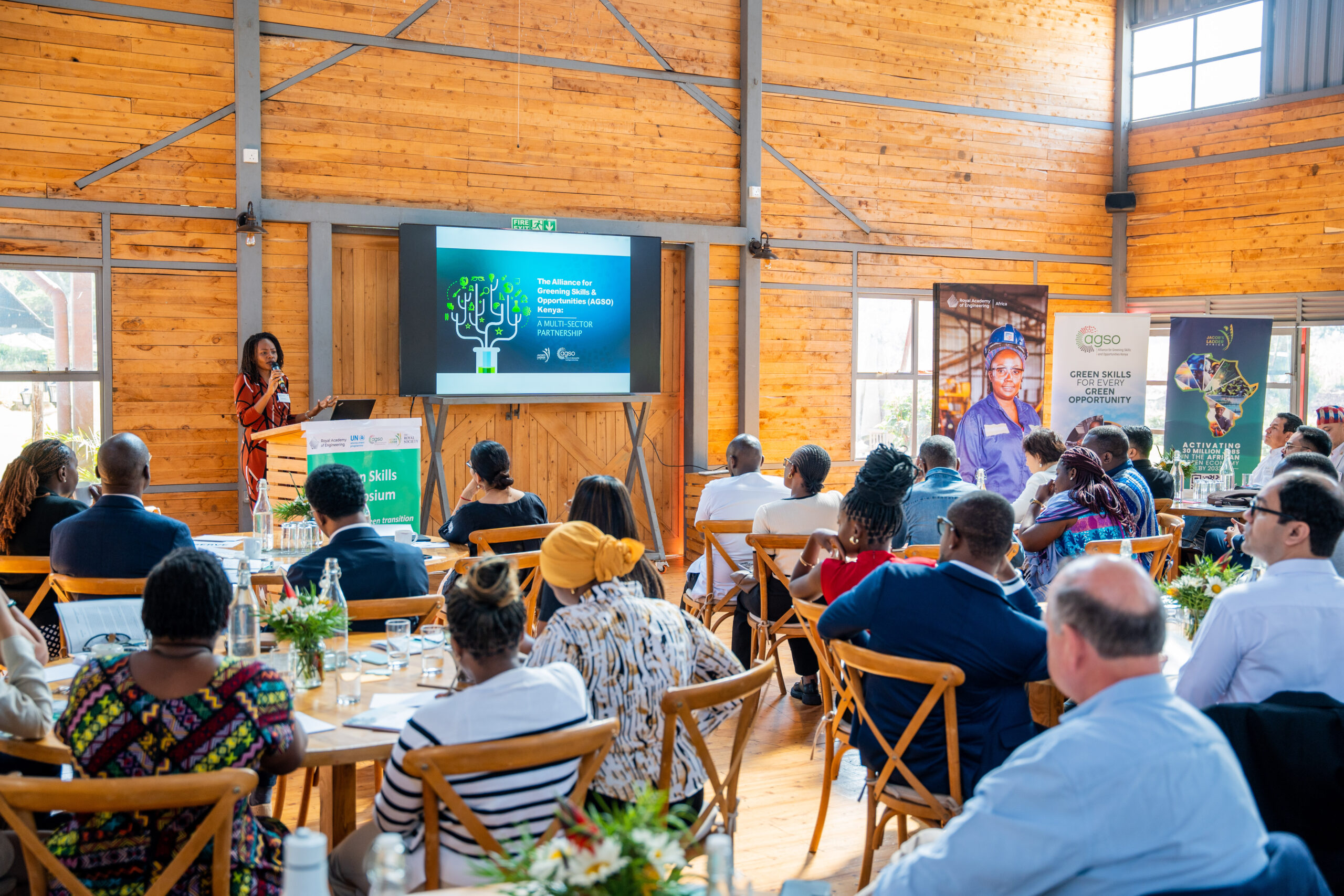
From 11–13 February 2026 in Nairobi, Kenya, JLA and the Alliance for Greening Skills and Opportunities-Kenya (AGSO), partnered with the Royal Academy of Engineering (RAENG), and the United Nations Environment Programme (UNEP) to convene the Green Skills Symposium under the theme, Accelerating the Green Transition through Skills and Innovation.
The event was a strategic interrogation of a harder question to do with how Africa’s green transition translates into labor absorption at scale because without enterprise pathways, skills remain theoretical and without jobs, demographic momentum becomes economic instability. Across the world, the transition toward clean energy and sustainable development is creating jobs. According to the Renewable Energy and Jobs Annual Review 2024 by the International Renewable Energy Agency (IRENA) and the International Labour Organization, global renewable energy employment reached at least 16.2 million jobs in 2023, up from 13.7 million in 2022, a record jump reflecting rapid sectoral growth.
Furthermore, investments in nature-based solutions could generate millions of additional jobs worldwide if scaled with targeted policies, for example, up to 20–32 million new jobs by 2030 through expanded implementation of ecosystem-focused strategies, according to a report by the International Labour Organization (ILO.
Africa’s urgency is demographic. Over 60% of the continent’s population is under 25 according to the African Economic Outlook, 2025 by AfDB. Many youth are neither in education, employment, nor training (NEET). An estimated more than one in five African youths (around 23%) falls into this category, revealing a major obstacle to productive participation. Yet nearly one in five young Africans are not in employment, education, or training. More critically, over 85% of employment in Sub-Saharan Africa is informal according to the International Labour Organization (ILO). Informality limits productivity, income security, and access to finance. Informality and underemployment contribute heavily to “working poverty,” where many so-called “employed” workers still live on low wages without pathways to higher productivity.
At the heart of Africa’s labour issue is not a lack of ambition among youth but a disconnect between skills acquisition and market integration. Common barriers include lack of formal recognition for skills acquired informally, skills certification systems that are not aligned with market demand and fragmented pathways between learning and enterprise development
These gaps often leave young people underprepared to enter higher-value segments of green sectors, from renewable energy to sustainable construction, where jobs are growing the fastest. These opportunities will only materialise at scale if skills ecosystems are robust, adaptive, and aligned to enterprise development pathways.
The Nairobi Symposium examined three levers:
- Innovation and scalable business models in sectors such as renewable energy and green construction.
- Recognition of Prior Learning (RPL) to formalise skills acquired in the informal economy, particularly in high-growth green sectors.
- Participatory ecosystem alignment, ensuring training institutions, policymakers, and industry respond to real market demand.
The meeting demonstrated that cross-sector dialogue can pinpoint practical barriers, that skills and certification must be rooted in labour market realities, and that partnerships spanning government, industry, and ecosystem players are essential. JLA is committed to bridging the gaps between training and market entry, and to only conveying but also turning youth skills into scalable green enterprises that address unemployment, decarbonise economies, and strengthen resilience.