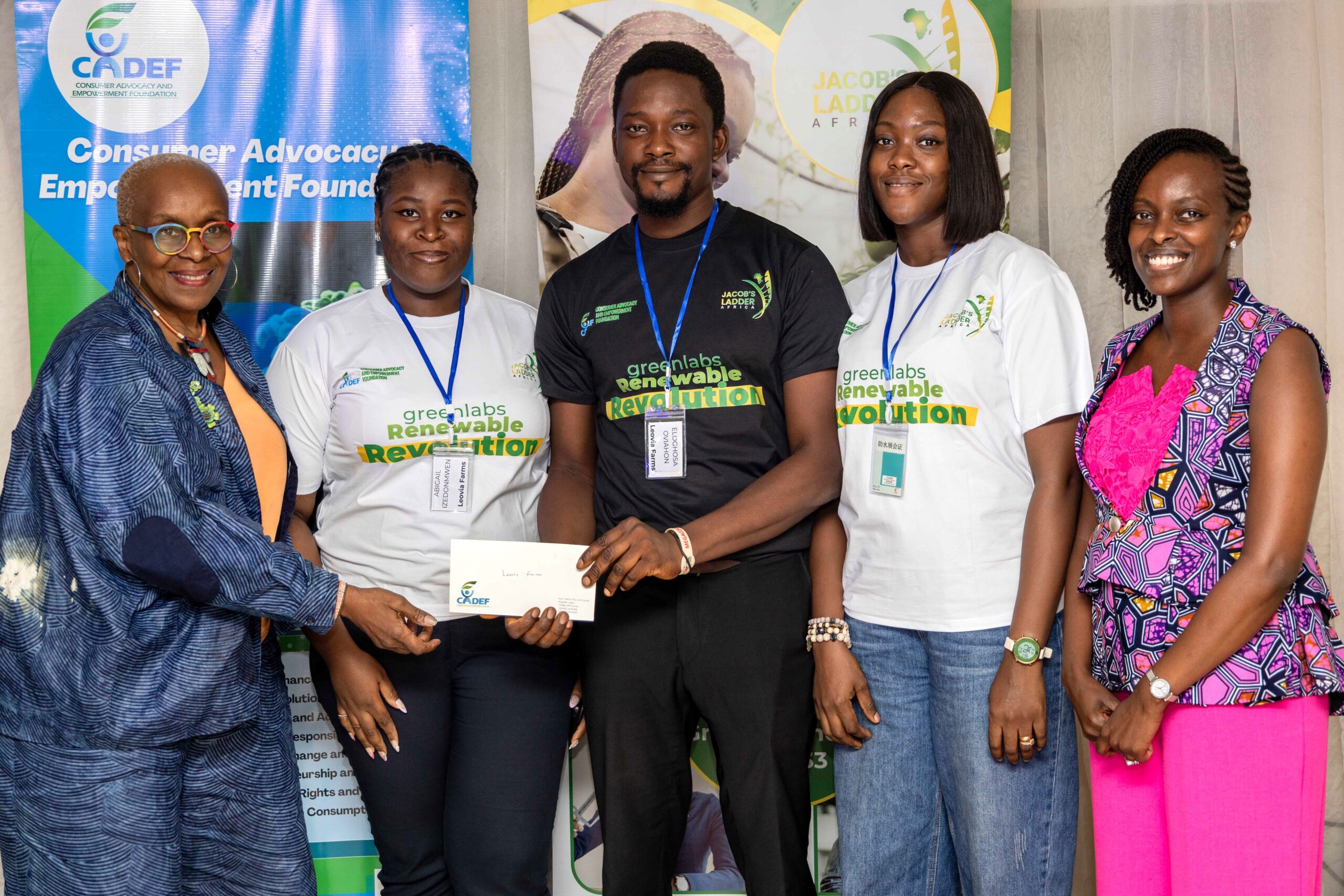
JLA, in partnership with the Consumer Advocacy and Empowerment Foundation (CADEF), rolled out the greenlabs: Powering Food Systems Innovation Challenge, culminating in a high-impact Demo Day on 13 February 2026 in Lagos, Nigeria. The four-week challenge focused on enterprise growth, innovation refinement, and market readiness at the nexus of renewable energy and food systems transformation.
Sixteen innovators qualified after the four weeks and got the opportunity to engage regulators, ecosystem enablers, development partners, and media during the long awaited demo day. At the close of the pitch session, three startups namely Geocycle, Ecobag Mart, and Agricool Logistics, secured pre-seed funding to advance prototype development, conduct market validation, formalize business structures, and accelerate go-to-market strategies. This was alongside fellow finalists Leovia Farms and Dry Heat Solutions, who now all enter a nine-month incubation phase aimed at building commercially viable green enterprises through JLA’s entrepreneurship incubator programme, greenlabs®.
In her address, Karen Chelang’at, Chief Innovation Officer at JLA, reminded them that, “Funding is only the beginning. The real success will be market-ready businesses that create jobs and deliver measurable community impact.”
Similarly, CADEF’s Executive Director, Prof. Chiso Ndukwe-Okafor, emphasized that the transition from innovation to enterprise is central, with founders capable of scaling responsibly and sustaining long-term impact. “I want you to lead the charge, not just with innovation, but also with integrity,” she further stated.
Agrifood systems account for approximately one-third of global greenhouse gas emissions according to the Food and Agriculture Organization (FAO). At the same time, the green transition is labor-generating. The International Labour Organization (ILO) estimates that greening the global economy could create 24 million net new jobs by 2030.
The importance of the challenge was macroeconomic. An estimated 60% of the total crop harvested is lost due to post-harvest losses in many African countries, leading to high rates of hunger, decreased edible food mass, reduced nutritional value, low income for farmers, and compromised food security as well as livelihoods, largely due to inadequate storage and cold-chain infrastructure.
In Nigeria, agriculture contributes about 22% of GDP, yet unreliable electricity access reaching roughly 55–60% of the population limits value addition, cold-chain development, and market efficiency. Renewable energy-powered storage, circular packaging solutions, and climate-smart logistics directly target these systemic constraints and by supporting youth-led innovations like those displayed during the challenge, these structural bottlenecks have a real chance of being solved within Nigeria’s food–energy economy.
Africa must generate millions of productive jobs annually to stabilize its demographic dividend and a potent pathway for the close of the employment gap requires enterprise formation at scale.In high-growth, high-risk environments, scalable green ventures must move beyond ideas into formalized, job-creating businesses capable of strengthening Nigeria’s food-energy systems while contributing to Africa’s broader green economic transformation.